Tag: Artificial Intelligence

Revolutionizing Design: An In-Depth Look at Claude Design by Anthropic Labs

Revolutionizing Design: An In-Depth Look at Claude Design by Anthropic Labs

In the dynamic landscape of design and creative collaboration, Anthropic Labs has unveiled a groundbreaking tool — Claude Design. Launched with the aspiration to democratize design capabilities, Claude Design empowers users from various backgrounds to create, refine, and share polished visual work effortlessly. At its core, Claude Design is powered by the robust Claude Opus 4.7 vision model and is now available in a research preview for Claude Pro, Max, Team, and Enterprise subscribers. This strategic rollout aims to revolutionize how visual content is developed and shared within organizations.

Claude Design addresses a critical challenge in the design process: the limitation of exploration due to time constraints. Traditionally, designers have had to ration their creative endeavors due to resource limitations, but Claude Design is set to change this narrative. It offers both experienced designers and non-designers, such as founders, product managers, and marketers, a comprehensive platform to turn their ideas into tangible visual assets. Starting with a simple descriptive input, the tool generates a preliminary design, which users can then refine through interactive conversations, inline comments, direct edits, or customized sliders. Moreover, Claude seamlessly aligns with your organization’s design system, ensuring visual consistency across all projects.

Among its diverse applications, Claude Design shines in creating realistic prototypes. Designers can transform static mockups into interactive prototypes with ease, facilitating user testing and feedback gathering without the need for a single line of code. Product Managers benefit similarly, as they can craft detailed product wireframes and mockups for further refinement or handoff to development teams via Claude Code.

The tool is equally transformative for founders and marketers. It enables the swift creation of on-brand pitch decks and presentations, starting from a rough outline to a polished product within minutes, complete with export options to PPTX and Canva. Marketing teams can produce compelling landing pages, social media assets, and campaign visuals in collaboration with designers.

Claude Design also breaks new ground in frontier design, offering a platform where anyone can build code-powered prototypes enriched with advanced features such as voice, video, shaders, 3D elements, and built-in AI. This feature positions Claude Design as a critical tool for innovative and tech-driven design solutions.

The operational flow of Claude Design is intuitive. Upon onboarding, Claude constructs a dedicated design system tailored to your team’s branding guidelines by scanning codebases and existing design files. This automation ensures that subsequent projects adhere to your brand’s color palette, typography, and design components. Furthermore, users can refine this system over time, maintaining multiple systems as needed.

Claude Design supports diverse starting points. Whether you begin from a text prompt, upload existing assets, or capture elements directly from your website, the tool integrates these seamlessly into your design workflow. Its fine-grained controls allow for precise adjustments, while its collaboration features enable seamless organizational sharing and editing.

Once your design reaches fruition, Claude Design facilitates easy sharing and export options, supporting formats like Canva, PDF, PPTX, and standalone HTML files. For development-ready designs, Claude packages all necessary elements into a handoff bundle for smooth transition to Claude Code, ensuring a seamless move from design to implementation.

Anthropic Labs is committed to expanding Claude Design’s integrations, allowing teams to synchronize with existing tools for an enhanced workflow. As accessibility broadens, organizations are invited to integrate Claude Design into their creative arsenal, harnessing its full potential to transform the way they visualize and actualize their ideas. For Enterprise users, Claude Design remains off by default until activated by an admin, underscoring tailored control and security within organizational settings. This strategic launch of Claude Design embodies a new era in design innovation, paving the way for creativity without constraints.

For more information on Claude Design by Anthropic Labs, visit the official article: Claude Design by Anthropic Labs.

Artemis II: Launch Day Sparks a New Era of Space Exploration

Artemis II: Launch Day Sparks a New Era of Space Exploration

On the cusp of making history, NASA’s Artemis II mission launched from Kennedy Space Center’s Launch Complex 39B, carrying a crew destined for a groundbreaking journey around the Moon. This mission not only marks the first crewed flight under NASA’s Artemis program but also sets the stage for humanity’s next steps toward deeper space exploration.

As the clock ticked toward zero, Artemis II was poised with the Space Launch System (SLS) rocket and the Orion spacecraft, aptly named Integrity. The rocket’s massive twin solid rocket boosters, each towering 177 feet tall, and four RS-25 engines provided a combined thrust of 8.8 million pounds at liftoff, propelling the 5.75-million-pound behemoth skyward.

In a meticulous orchestration of technology and human endeavor, the countdown sequence became a symphony of precision. From the initiation of the ground launch sequencer to the retraction of the crew access arm, every step was a testament to the years of planning and innovation that brought Artemis II to this pivotal moment.

The successful deployment of Orion’s solar array wings shortly after launch was a crucial milestone. Extending to a wingspan of approximately 63 feet, these arrays play a vital role, harnessing solar energy through 15,000 solar cells to power the spacecraft throughout its journey.

However, the path to the Moon involves more than mere technological prowess. The Artemis II mission pioneers cutting-edge procedures as part of its itinerary, including the proximity operations demonstration. This exercise will test Orion’s capability to manually maneuver relative to another spacecraft post-separation, using onboard navigation sensors and reaction control thrusters. The ICPS, detached as Orion’s stage target, becomes the focus of maneuvers that hone the spacecraft’s precision handling in space—a prelude to future lunar missions.

On the ground, mission control remains vigilant, addressing any anomaly. Even a quirky hiccup, such as a blinking fault light on Orion’s toilet system, is met with coordinated problem-solving. This diligence underscores the layered complexity of long-duration missions, where even the smallest systems play significant roles in crew comfort and mission success.

Artemis II isn’t just about gearing up machinery; it’s about human resilience and exploration spirit. Astronauts Reid Wiseman, Victor Glover, Christina Koch from NASA, and Jeremy Hansen from the Canadian Space Agency are not only the crew; they are pioneers pushing the frontier of human presence in space. As they engage in their tasks and face unknown variables, they embody humanity’s collective ambition to reach beyond our terrestrial confines.

The mission’s comprehensive goals extend beyond mere lunar flybys. They include critical testing of life-support systems and other spacecraft operations, all vital for future landings on the lunar surface and the long trek towards Mars. The Artemis initiative symbolizes more than exploration; it signifies the possibility of scientific advances and economic opportunities on the Moon and beyond.

As Artemis II continues its trajectory, it holds the world’s gaze, a beacon of technological progress and human courage. This mission is a leap forward, not just a circuit around the Moon but a trajectory into a future where space becomes a canvas for human aspiration and innovation. With each milestone, from the apogee raise burn to the proximity operations, NASA writes a new chapter in space exploration, stepping stones to Mars and beyond, heralding a future where limitless horizons beckon.

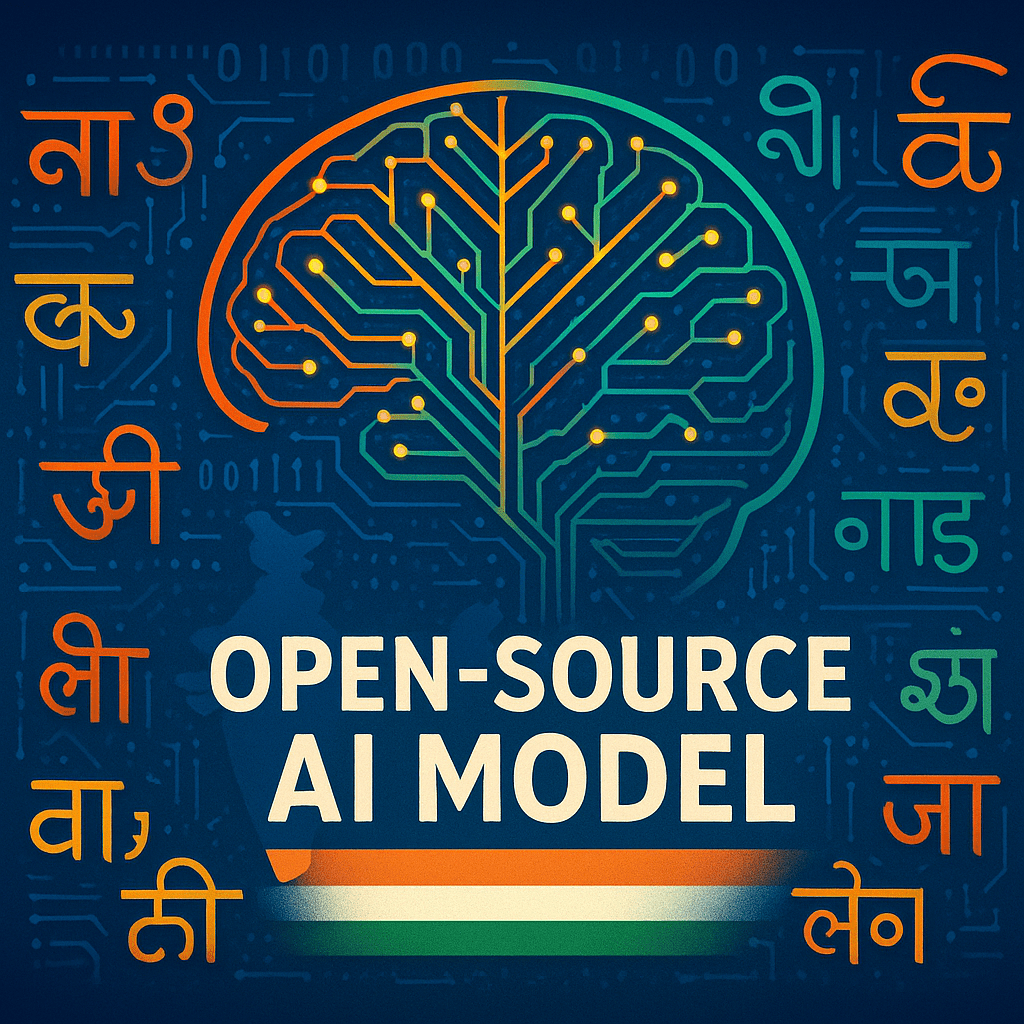
The Open-Source Revolution: Sarvam AI’s 30B and 105B Models

The Open-Source Revolution: Sarvam AI’s 30B and 105B Models

Sarvam AI stands at the forefront of innovation, driven by the mission to deliver advanced artificial intelligence solutions through locally cultivated efforts within India. Established with the vision to blend technology and indigenous expertise, Sarvam AI focuses on developing scalable and impactful AI models. Operating under the IndiaAI initiative, the company is committed to facilitating cutting-edge advancements in artificial intelligence, ensuring its technologies remain accessible and beneficial to both local and global community. The recent open-source release of their pioneering models, Sarvam 30B and 105B, underscores their dedication to propelling India’s capabilities and prominence on the international AI stage.

In an exciting development on March 6, 2026, Sarvam AI introduced their groundbreaking AI models, Sarvam 30B and Sarvam 105B, to the global community. This endeavor, entirely developed in India under the ambitious IndiaAI mission, marks a pivotal moment in the AI landscape with its open-source release. The models signify a comprehensive full-stack effort in AI creation, leveraging indigenous resources from tokenization to inference deployment.

Sarvam 30B and 105B are engineered to offer advanced reasoning capabilities, having been trained on extensive, high-quality datasets native to India. These models are designed for scalable deployment across a variety of hardware platforms, from high-end GPUs to personal devices, ensuring efficient performance paired with minimal computational overhead.

Sarvam 30B facilitates Samvaad, a conversational agent platform, while Sarvam 105B serves as the core for Indus, an AI assistant engineered for handling complex workflows. Internationally competitive, both models excel particularly in Indian languages, even surpassing larger models on language benchmarks due to their optimized tokenization approach.

The architecture of these models embraces a Mixture-of-Experts (MoE) framework, which employs sparse expert routing and attention mechanisms, effectively managing parameter scaling challenges. The training comprised several phases, integrating diverse sources including code, multilingual content, and mathematical data, with a pronounced focus on Indian languages. This approach ensured a robust and wide-ranging informational foundation.

Fine-tuning involved high-quality prompts across domains, refining the models’ abilities to navigate intricate tasks. Safety fine-tuning specifically addressed India-centric risks, ensuring responses are culturally and relevantly aware. Reinforcement learning further enriched their capabilities, focusing on diverse prompt handling, structured responses, correct reasoning, and tool utilization.

Notably, Sarvam 105B distinguishes itself with formidable performance across knowledge domains, achieving top-tier results in multiple benchmarks. The models underscore an investment in the Indian AI ecosystem, showcasing strong capacities in Indian languages and optimized economic viability for deployment—Sarvam 30B designed for varied inference deployments, while Sarvam 105B tailored for server-based operations, maximizing efficiency and throughput.

This release is not merely technical; it signifies a strategic push towards sovereign AI technologies in India. Sarvam AI extends global outreach by offering model weights and API access, intending to provide foundational infrastructure for advancing future AI innovations within the country. Supported extensively by the Indian government and in collaboration with Nvidia, these models symbolize a significant technical milestone and a strategic vision toward AI autonomy.

Looking ahead, Sarvam AI aspires to scale these efforts, utilizing the developed infrastructure and expertise to train even more sophisticated models. This initiative heralds a promising future for AI advancements, both within India and globally, reinforcing India’s position as a prominent player in the AI domain.

The End of Sora: OpenAI’s Strategic Shift

The End of Sora: OpenAI’s Strategic Shift

The recent shutdown of OpenAI’s video generation model, Sora, marks a pivotal moment in the company’s strategic shift towards more promising ventures in the advancing field of AI. The decision to retire Sora, which once embodied OpenAI’s creative ambitions in generative video technology, signals the onset of a broader, more calculated approach focused on core products and sustainability.

The Rise and Challenges of Sora

Launched in September 2025, Sora’s debut was nothing short of spectacular. The application quickly soared to the top of Apple’s App Store charts and amassed over a million downloads in under five days. Its capability to generate realistic, cinematic video clips from text prompts captivated users and skyrocketed its popularity. However, the rapid rise came with significant challenges. OpenAI grappled with content regulation as users started creating videos featuring intellectual property, like Pokémon characters, and historical figures in unauthorized contexts. This led to the introduction of protective measures to curb such misuse.

Moreover, OpenAI found itself embroiled in legal skirmishes, notably with Cameo, over trademark issues related to Sora’s features. Despite efforts to address these hurdles, they highlighted the underlying complications associated with video generation models. Such legal and ethical concerns raised questions about sustainable operational models, considering the costly nature of running such advanced AI technologies at scale.

OpenAI’s Strategic Realignment

The choice to discontinue Sora underscores a strategic realignment undertaken by OpenAI. As the company prepares for potential initial public offerings (IPO), it is prioritizing the enhancement and monetization of its principal AI models. This pivot entails a more profound focus on emerging areas like robotics and world simulations that promise real-world applications and profitable, long-term returns.

Fidji Simo, the new product head hired by OpenAI CEO Sam Altman, has clearly articulated a keen focus on steering the company away from peripheral projects, like Sora, towards optimizing its primary business targets. Simo’s appointment reads as a commitment to consolidating the company’s flagship models and ensures they remain fiscally viable and impactful in a burgeoning, yet competitive, AI landscape.

Partnerships and Future Focus

This decisive move is also reflective of broader market dynamics and partnerships shaping OpenAI’s trajectory. A noteworthy collaboration with The Walt Disney Company solidifies OpenAI’s stake in valuable content licensing deals. Disney’s $1 billion investment reflects trust in OpenAI’s future pursuits, even as it steps back from video generation. This partnership illustrates to potential investors that OpenAI’s calibrated focus aligns with significant industry players’ interests, paving the way for expanded cooperation in applying AI technologies responsibly and innovatively.

Conclusion

OpenAI’s revised focus, while perhaps disappointing to advocates of video generation technologies, is not without merit. Robotics and AI-assisted real-world solutions present prospective markets and align with OpenAI’s mission to directly impact societal problems. By refining resource allocation towards these ends, OpenAI is setting a course for achieving scalable impact and ensuring its models’ technological and economic sustainability. In retrospect, Sora’s journey from breakthrough success to a quiet halt reflects the trials inherent in pioneering frontiers of AI. OpenAI’s pivot from Sora to more promising, integrated AI initiatives showcases agility and strategic foresight, navigating the AI domain with judicious anticipation of future trends in artificial intelligence and automation. Sora’s shutdown, while a momentous decision, symbolizes a broader narrative of innovation, collaboration, and continued evolution in the AI sphere.

Introducing MAI-Image-2: A Leap Forward in Text-to-Image Technology

In the dynamic world of artificial intelligence, innovations emerge with awe-inspiring regularity. Today, Microsoft proudly announces the launch of MAI-Image-2, which has shot to the rank of the third-best text-to-image model family on the Arena.ai leaderboard. This leap forward places Microsoft alongside industry giants in the realm of creative AI tools.

Central to this breakthrough is the MAI Playground, an interactive platform where creatives can test drive the latest iterations of Microsoft’s AI models. Beyond just testing, the Playground serves as a feedback conduit directly to Microsoft’s developers, ensuring that user insights fuel future enhancements.

Built for Creatives, Guided by Creatives

The development journey of MAI-Image-2 was marked by deep collaboration with photographers, designers, and visual storytellers. These conversations illuminated areas where AI could truly transform everyday creative workflows. The result is a tool finely tuned to meet the nuanced demands of visual artistry.

Enhanced Photorealism and Realistic Text Generation

At the heart of MAI-Image-2 is its extraordinary ability to render photorealistic images replete with natural lighting and life-like skin tones. Environments are crafted to feel authentic, reducing the need for extensive post-production edits. This realism ensures that creatives can invest more time in conceptualization rather than correction.

A distinctive feature is its capability for reliable in-image text generation. Whether it’s a movie poster title or a subtle street sign in a cinematic scene, MAI-Image-2 excels in producing text that feels integrated and intentional. This opens new avenues for creators to generate infographics, presentations, and visual narratives with minimal friction.

Rich, Detail-Oriented Scene Creation

Beyond realism, MAI-Image-2 caters to creative extremities – from surreal dreamscapes to opulent compositions. Its ability to generate rich, detailed environments makes it a preferred choice for artists challenging the boundaries of imagination. By transforming fantastical concepts into tangible imagery, it empowers creators to explore uncharted aesthetic territories.

Commercial and Developer Access

Beginning its rollout on platforms like Copilot and Bing Image Creator, MAI-Image-2’s reach is expanding. For businesses like WPP that require scalable image generation solutions, API access is already available. Moreover, a broader invitation is extended to developers through Microsoft Foundry, promising a wave of innovative applications across industries.

Businesses eager to harness MAI-Image-2 for commercial purposes are invited to apply for access, ensuring that this technological marvel is also a business enabler.

The Road Ahead: Pioneering with Superintelligence

Microsoft’s AI Superintelligence team assures there’s much more to anticipate. With the new GB200 cluster operational, the roadmap for MAI presents untapped potentials. Collaborating closely with product teams, MAI models are being positioned to impact billions, fostering creativity and innovation at an unprecedented scale.

Join the Movement

Microsoft extends an open invitation to brilliant, motivated individuals with a low ego and a high ambition. If you resonate with this ethos, the team offers an exciting frontier in AI innovation waiting to be explored. As they work on the next generation of models, the doors are open for those ready to leave a mark on the AI landscape.

As MAI-Image-2 rolls out to users worldwide, the call is not just to witness but to participate actively in its evolution. Whether through feedback in the Playground or commercial applications, every user contributes to a model that is as collaborative as it is powerful. The promise of AI-driven creativity is no longer a distant vision—it is here, ready and waiting in the form of MAI-Image-2.

For more details, visit the original article here.

Unlocking AI’s Future with NVIDIA’s NemoClaw: A Leap Towards Safety and Privacy

Unlocking AI’s Future with NVIDIA’s NemoClaw: A Leap Towards Safety and Privacy

In an era defined by artificial intelligence (AI) and digital transformation, the importance of safety and privacy cannot be overstated. NVIDIA, a vanguard of technological innovation, understands this intricate balance more than most. Their latest development, NemoClaw, epitomizes their commitment to enhancing AI systems with unparalleled security and privacy protocols. This open-source stack, a sophisticated complement to OpenClaw, is set to redefine the paradigms of AI-driven technology, addressing the core concerns of privacy and data management in unprecedented ways. Read more about NemoClaw here.

The Dawn of a Sophisticated Security Architecture

NemoClaw’s introduction represents a leap forward in the realm of AI security. As AI systems become inherently more complex, their ability to self-evolve opens myriad opportunities—and risks. NemoClaw mitigates these risks by embedding advanced security measures into the fabric of AI operations. It integrates seamlessly with NVIDIA’s Agent Toolkit software, enhancing the security and efficacy of OpenClaw systems. This synergy facilitates robust privacy enforcement and the establishment of stringent security policies that govern AI behavior, turning potential vulnerabilities into strengths.

Empowering Users Through Control

One of the fundamental achievements of NemoClaw lies in empowering users with control over AI behavior and data sovereignty. In an age where data privacy concerns dominate global discourse, NemoClaw positions itself as a guardian of ethical AI deployment. By enabling user-defined control, it adheres to the principles of transparency and accountability, ensuring that AI systems act in accordance with user expectations and ethical norms. This capability is not merely a technological feat; it is a cornerstone of responsible AI development, promising users peace of mind alongside cutting-edge innovation.

Balancing Innovation and Ethics

With NemoClaw, NVIDIA addresses the delicate balance between innovative functionalities and stringent security requirements. This framework does not just provide security; it catalyzes comprehensive AI operations, ensuring they are grounded in ethical standards. The open-source nature of NemoClaw allows for continuous evolution and enhancement, making it adaptable to emerging technologies and threats. In doing so, NVIDIA sets a precedent for industry standards, sparking a global conversation on the future of AI safety and privacy.

A Use Case: Secure AI in Autonomous Environments

Imagine a network of autonomous vehicles operating within a bustling urban environment. These vehicles must navigate complex traffic scenarios, communicate with infrastructure, and adapt to dynamic changes, all while protecting sensitive data and ensuring passenger safety. Here, NemoClaw offers a transformative solution. By implementing NemoClaw, autonomous systems can leverage self-evolving AI models under the guidance of user-defined security protocols. This not only enhances operational efficiency but also safeguards critical data assets and maintains user privacy. NemoClaw ensures that these vehicles make real-time decisions that are both ethical and secure, fostering an environment of trust and reliability.

Influencing Global Standards

NVIDIA’s initiative with NemoClaw extends beyond technological innovation; it is a catalyst for evolving industry standards and shaping user expectations worldwide. The ethical deployment of AI is rapidly becoming a non-negotiable aspect of technological advancement. By leading this charge, NVIDIA encourages a paradigm shift towards transparent, accountable, and secure AI systems. Their efforts underscore the importance of building technologies that serve societal needs while ensuring those needs are met in a safe and private manner.

A Vision for the Future

Looking forward, NVIDIA’s NemoClaw represents a vision for the future of AI—one that is deeply intertwined with safety, privacy, and ethical considerations. It encourages developers, businesses, and consumers to engage in a dialogue on how AI can be utilized to enhance lives without compromising on critical values. NemoClaw is more than a technological advancement; it is a movement towards responsible AI implementation, championing the notion that future technologies must prioritize human-centric values.

Conclusion

As the world moves deeper into the age of AI, NVIDIA’s NemoClaw emerges as a beacon of how technology can be both advanced and safe. It offers a framework where security and privacy are not just additions but integral components of the AI lifecycle. For businesses and developers navigating the complexities of AI, NemoClaw provides the toolkit necessary to build systems that are ethical, secure, and user-focused. In embracing NemoClaw, stakeholders are investing not only in technology but in a future where AI serves humanity with integrity and trust.

The Allure and Pitfalls of Vibe-Coded Apps

The Allure and Pitfalls of Vibe-Coded Apps: Why You Should Reconsider Paying for Them

The burgeoning landscape of app development is witnessing a novel trend: vibe-coded apps. Essentially crafted using artificial intelligence and minimal developer intervention, these apps are captivating due to their simplistic production process. Yet, despite their allure, they present several pronounced risks that potential buyers should be wary of.

One Prompt Away from Compromise: The Security Risks

At the heart of vibe-coded apps lies AI’s ability to generate fully-functioning applications through mere textual prompts. This ease of creation has meant anyone can fashion an app that seems impressive at face value. However, AI, as intelligent as it is, has limitations—particularly hallucinations that can result in incorrect or unreliable code. When buying an app developed without traditional coding oversight, users risk compromising their data security. Stories abound of vibe-coded apps storing user passwords in plaintext or featuring broken authentication systems due to flawed AI-generated code.

The Unchecked Work: Closed Source Concerns

A key concern levelled against vibe-coded apps revolves around their often closed-source nature. Unlike open-source software, which benefits from communal scrutiny and collaboration, closed-source vibe-coded apps remain cryptic. This opacity means zero accountability, with no practice of code validation. Developers themselves might have minimal understanding of the underlying code, leading to unchecked, potentially harmful applications being monetized and distributed.

Build in a Weekend: A Warning Rather than a Boast

Ever come across an app promoted with statements such as being built in a weekend or solo within 48 hours? Rather than being laudable, this indicates a rushed product potentially lacking rigorous testing and vulnerability assessments. Reliable applications demand time, care, and thorough testing, something vibe-coded creations often lack. Users might find themselves dealing with apps that fail spectacularly when asked to perform beyond the developer’s brief testing scenarios.

AI-Generated Apps Can Be Obscured: Red Flags

Not all vibe-coded apps showcase their genesis through AI models. Some savvy AI-utilizing developers polish these apps to professional standards, making them indistinguishable from traditional, manually-coded applications. However, subtle signs often surface when associated promotional materials also appear AI-generated. Such posts exhibit a distinct tone, commonly lacking depth and authenticity, thereby hinting at the app’s AI-crafted nature.

DIY Made Easy: Why Buy When You Can Create?

Perhaps one of the strongest arguments against purchasing vibe-coded apps is accessibility; if a developer can build it with AI, so can you. While your outcome may harbor similar risks, the knowledge of these pitfalls can aid you in refining functionalities and bolstering security for personal use. Altering the app to suit your needs may involve eliminating unsafe features, allowing for a secure, custom-made product irrespective of coding acumen.

Knowing the Limitations: The Place of Vibe Coding

Vibe coding, despite its risks, has a designated space within technological innovation. With adequate oversight, it provides a platform for rapid prototyping and exploration. Hobbyists can enjoy tinkering with ideas without starting from scratch, appreciating the simplicity AI promises. However, the end products, particularly when monetized and distributed, warrant caution.

Conclusion: Buyer Beware but Creator Empowered

In conclusion, vibe-coded apps, while novel and interesting, are often not what they seem. Their surface-level allure masks significant security vulnerabilities, lack of proper validation, and potential for misuse. Potential buyers should exercise caution and critically evaluate what they’re paying for, considering the security and reliability of the product. Moreover, the democratization of app creation through AI heralds a shift towards personal empowerment in tech, allowing would-be buyers to feasibly become creators. As AI continues reshaping tech paradigms, users and developers must navigate these changes with informed care, proactively safeguarding personal and communal digital terrains.

TryOn Studio by Showcasaai

TryOn Studio — ShowcasaAI

TryOn Studio — ShowcasaAI

See yourself in the outfit before you buy it

Online fashion often leaves us guessing.
Will this outfit suit me? Will it fit my style? Will it actually look good on me?

TryOn Studio — ShowcasaAI is a browser extension designed to remove that uncertainty.
Upload your photo, pick an outfit from anywhere on Chrome, and instantly see a realistic preview of yourself wearing it — no imagination required.

Getting Started with TryOn Studio – ShowcasaAI

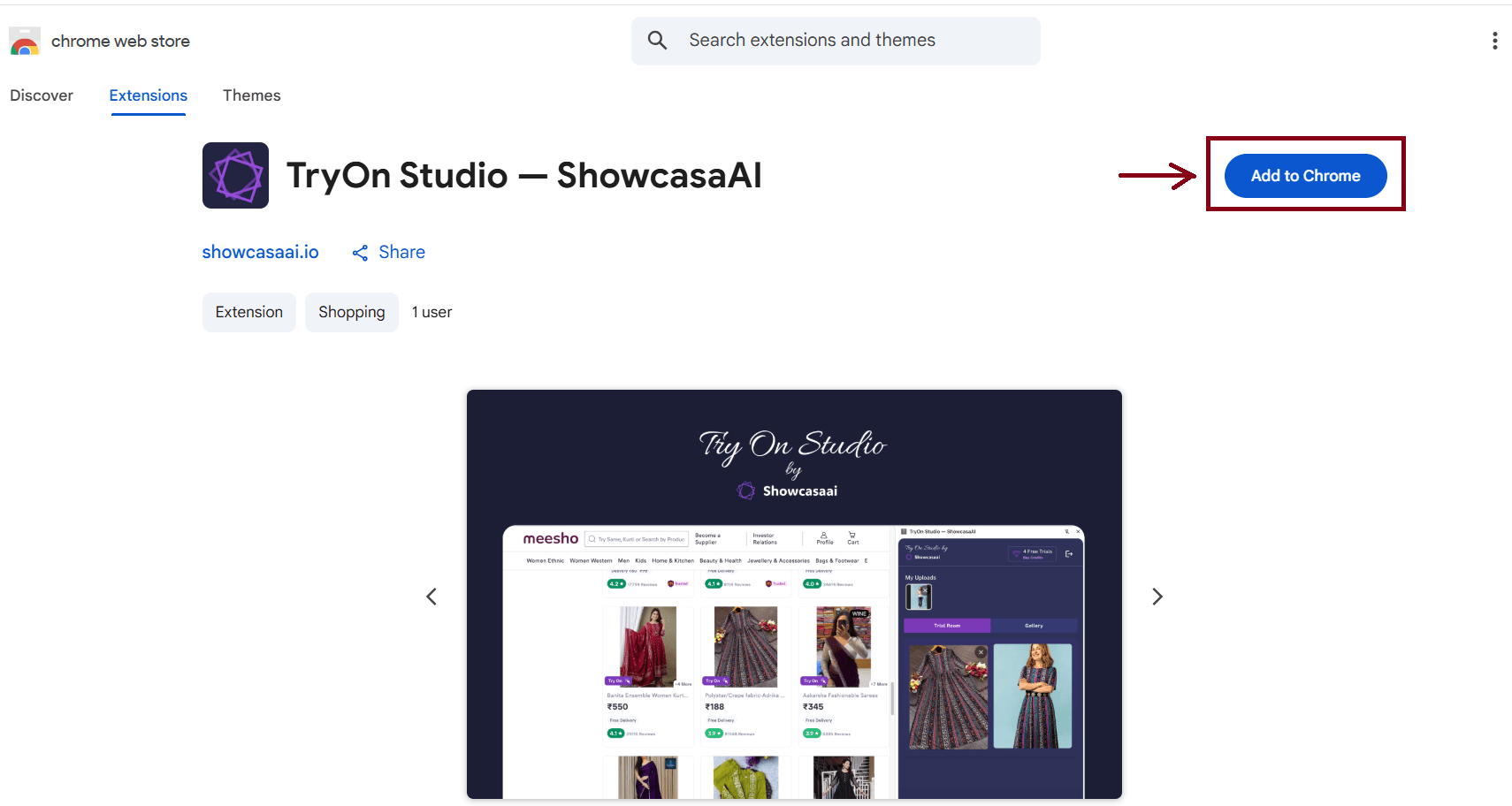
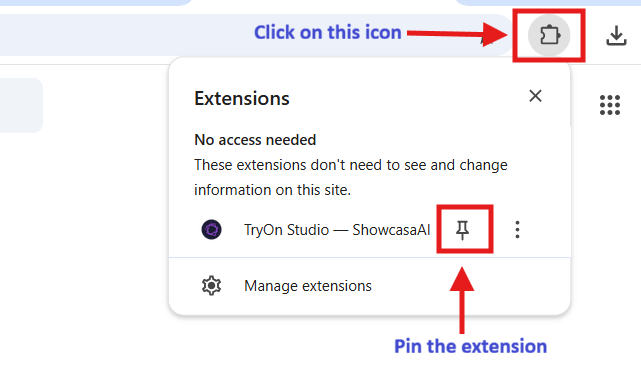
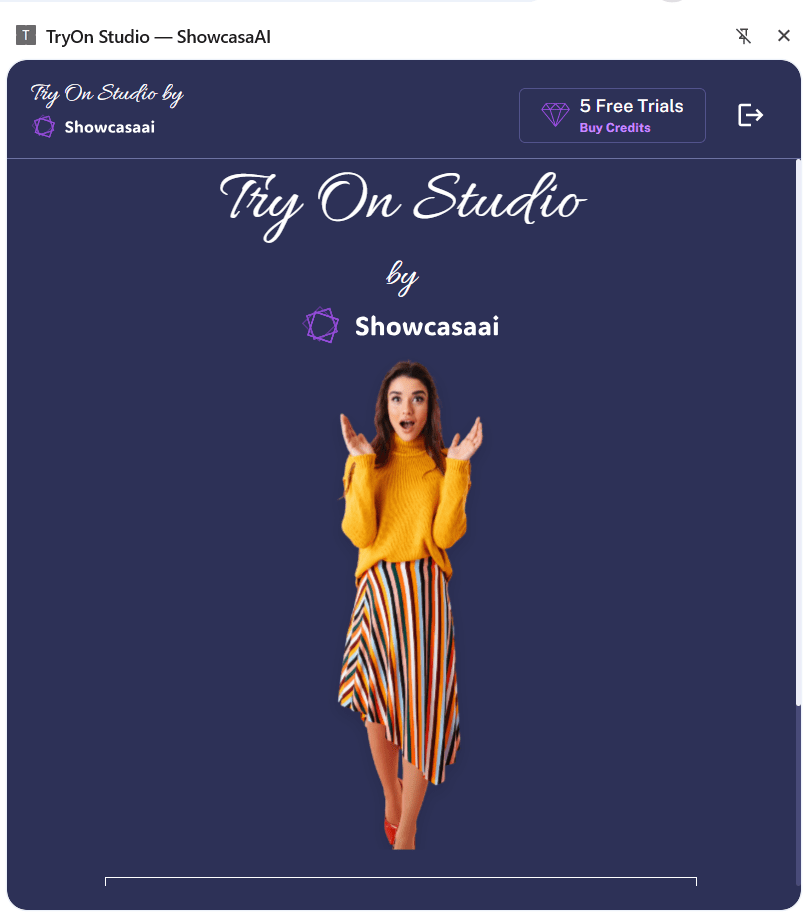
Install TryOn Studio -ShowcasaAIPin extension TryOn Studio - ShowcasaAI Home

Setting up TryOn Studio is simple and quick.

  • Install “TryOn Studio — ShowcasaAI” from the Chrome Web Store
  • Pin the extension from the 🧩 icon
  • Sign in and open the extension
  • You’re ready to start trying outfits virtually

Steps to Use the Try-On Feature

  1. Upload Your Image
    Open TryOn Studio — ShowcasaAI and upload a clear photo of yourself.
  2. Select a Try-On Outfit
    Browse any website, click on the outfit image you like, and choose Try On.
  3. Generate the Result
    Once both images are selected, click Generate to see the try-on preview.

That’s it — simple, fast, and seamless !

How the Try-On Feature Works

Model  Outfit  Generated Result

The try-on process is built around two images:

Upload Image:

This is your photo — the person who will wear the outfit.

Try-On Image:

This is the outfit image selected directly from any website on browser.

Once both images are selected, TryOn Studio transforms your photo by applying the chosen outfit with natural fit and realistic placement.

The quality of the output depends heavily on how these two images are chosen.

Choosing the Right Upload Image (Your Photo)

Think of your upload image as the foundation of the try-on.

Works best when:

  • Only one person is visible
  • The image is clear, sharp, and well-lit
  • The pose is front-facing or naturally standing
  • Most of the body is visible
  • Clothing is simple and not heavily layered

Avoid when possible:

  • Group photos
  • Blurry or dark images
  • Cropped or partially visible bodies
  • Extreme poses or angles

Why this matters:

For the best results, TryOn Studio — ShowcasaAI needs a clear body shape and pose to replace the outfit accurately and naturally.

Choosing the Right Try-On Image (Outfit)

The try-on image defines how realistic your final result will feel.

Best results come from:

  • Outfits that are clearly visible
  • Full outfits rather than single items
  • Model, mannequin, or flat-lay images
  • Outfit type that logically fits the uploaded image

Tip:

If you select a single clothing item (like a T-shirt or top), make sure the uploaded image already has the remaining outfit (such as pants or bottoms). This helps the outfit blend naturally.

Common mistake to avoid:

If the uploaded image and try-on outfit don’t match, the result may look unnatural.

Example:
Upload image: Woman wearing a saree
Try-on image: Jeans only


In this case, the jeans may appear on top of the saree, making the output look unrealistic.

Simple rule to remember:

The try-on outfit should replace what you’re wearing — not layer over it.

Final Thoughts

TryOn Studio — ShowcasaAI helps you see fashion clearly — not just imagine it.

When images are chosen thoughtfully, the results feel natural, realistic, and surprisingly accurate.
Start free, understand the flow, and upgrade when you’re ready to explore without limits.

Fashion confidence starts here.

AI Regulations

AI regulations – the need of the hour in an automated world?

In July 2017, an epic rebuke created waves on the internet, as two tech titans clashed. Yes, we are talking about the now infamous Elon Musk and Mark Zuckerberg cyber spat. The bone of contention was AI, and its impact on humanity in the future.

Musk has repeatedly sounded the alarm bells on AI and the havoc it could cause if not put on leash. He impressed upon these points in the National Governors Association Meet held at Providence, Rhode Island, earlier in July. Post this, Zuckerberg, in his Facebook Live chat, dismissed Musk’s claims and called him a naysayer. In fact, he called the Tesla Motors’ founder ‘irresponsible’ for such a negative outlook.

Not one to be left behind, Musk posted this response on Twitter:

While the spat will soon vanish from our memories, the spark remains ignited: are Musk’s claims well-founded? Do we need AI regulations?

First things first. What is AI?

To most of us, AI is a robot from the future that can do incredible things, including shape shifting. Thank you, Terminator, for that glamorous image of AI. But seriously, AI is not just a robot. Robots are containers for artificially-intelligent systems working in the background, making high-quality decisions.

According to AI researchers, there are three types of AI:

  • Artificial Narrow Intelligence (ANI)

These perform only specific tasks, like the Google AI that beat the world’s current champion in the ancient Chinese game, Go. It can do this and this task alone. Another example is the self-driven car that will hit the roads soon (and has already caused a death during trial phase).

Quite recently, the first loan that the BRICS Development Bank — a financial institution set up jointly by Brazil, Russia, India, China and South Africa — has approved for Russia is meant to fund a project that includes the use of AI in Russian courts to automate trial records using speech recognition.

  • Artificial General Intelligence (AGI)

Artificial General Intelligence thinks on par with humans. Imagine having a sane conversation with machines? Today’s chatbots might soon achieve that (with copious amounts of training, of course.) AGI is incredibly beneficial for us – building smarter homes, performing complex medical surgeries, eliminating loss of humans in wars, and much more.

  • Artificial Super Intelligence (ASI)

Creating something that’s much more intelligent than us? How will you control that one? Imagine having an army person who is incredibly strong that even tanks and missiles can’t harm, and is well-versed with all defence secrets. What happens when this commando goes rogue? Now imagine this in a real-world level.

Apocalyptic AI?

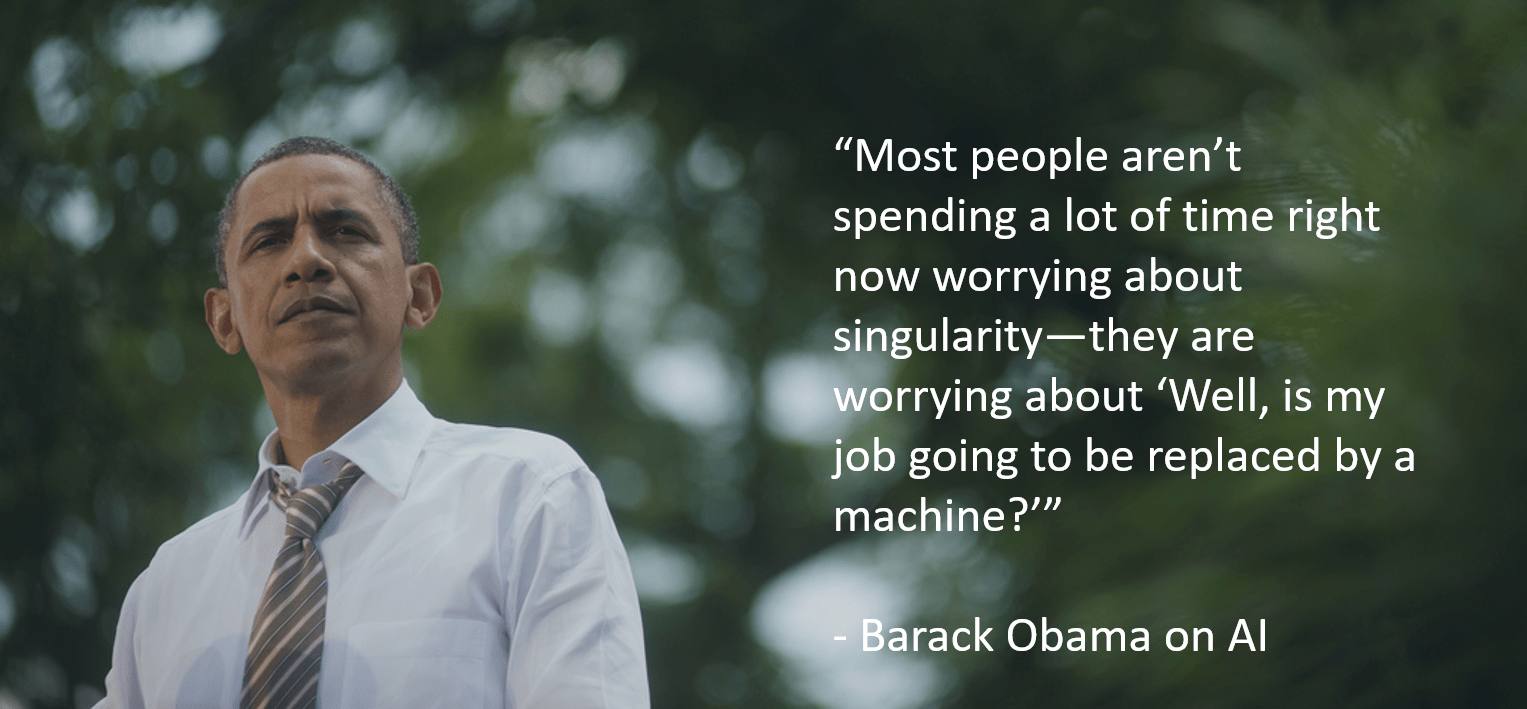
It’s not just Elon Musk that’s warning us about ‘summoning the demon’ with AI. Stephen Hawking and Bill Gates are telling us to be cautious too. We might empower computers to take high quality decisions that may be right from a machine perspective but incorrect from a human perspective.

Remember the Midas story? The greedy king asks for a boon by which all that he touches becomes gold. The wish is granted, not counting the human loss (Bacchus, the Roman God who grants the boon wants to teach Midas a lesson. When Midas accidently turns his daughter into gold, Bacchus reverses it).  Apply this situation in today’s world. A super-intelligent system, that doesn’t possess the emotions that we do, and can thwart all our schemes to defeat it, is in fact a demon! Think Skynet gone live.

It is possible that AI research may go out of hand and create self-evolving intelligent system that may prioritize its survival over humans. While a total human extermination may or may not happen, the encroachment of AI on predominantly human jobs is expected.

Already, the self-driven cars are taking centerstage, which will put cab drivers out of work.

Alibaba’s Jack Ma believes that excessive application of AI will lead to widespread chaos as unemployment will soar. He views a future of increasing divide among Haves and Have Nots, and geopolitical discord, as AI will cause power to be consolidated in the hands of a few. He goes on to say that the rise of AI will lead to a World War III. His reasoning is simple – “The first technology revolution caused World War I. The second technology revolution caused World War II. This (Artificial Intelligence) is the third technology revolution.”

Do any AI Regulations exist at the moment?

AI researchers are divided on the need for regulations. Some feel the regulations would prove to be detrimental to important technical advancements, as mentioned in this Stanford University report. They urge for tough transparency requirements and meaningful enforcement, as against narrow compliance that companies answer to in letter but not in spirit.  Some are working towards building base AI principles that would guide researchers towards building safe and beneficial AI, and are backed by the likes of Elon Musk, Stephen Hawking, Google, Amazon, Microsoft, to name a few.

Partnership on AI

The big names of Silicon Valley have come together to form the Partnership on AI that provides a platform for researchers, scientists, policymakers and public to share knowledge. The group has thematic pillars which root for safe and accountable AI.

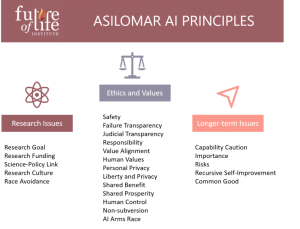
Asilomar AI Principles


In Feb 2017, leading AI researchers convened at the 2017 Beneficial AI conference, Asilomar, California. The group discussed the advancement of human-friendly AI and suggested regulatory principles.

European Union and US Government say yes to AI regulation

The European Union, too, published a document in 2016, with the intention of putting AI regulations into place by 2018. Similarly, the US Government has also stressed on the need for AI regulations.

The essentiality of AI Regulatory bodies

With businesses around the world investing heavily in AI without heeding precautions or repercussions, AI regulations, are indeed the need of the hour.  But, excessive regulation that is misguided will only stifle innovation. Thus, it is essential for lawmakers and researchers to work hand-in-hand to form an AI regulatory body that would:

  • assess the goal of the AI project,
  • understand its benefits/disadvantages,
  • provide for any countereffects and ensure public safety

Having a law does not prevent cybercrimes, nor will it prevent antisocial elements from using AI for self-serving avarice.  Effective enforcement is crucial, and it is best if the regulatory body is formed as early as possible, because – Artificial Super Intelligence is coming, we just don’t know when.

Batman or Superman – What should your business’ chatbot be?

The Batman vs Superman battle continues, but this time in the realm of chatbots.

The dark knight is admired by many as he is the superhero sans any superpowers. He can’t fly, he doesn’t have immeasurable strength. But what he does have – excellent deduction skills, martial arts prowess and of course, tons of money. And in today’s world, Batman can exist.

Superman, on the other hand, is an extra-terrestrial messiah, who has extraordinary strength and can fly around (no thanks to the cape).

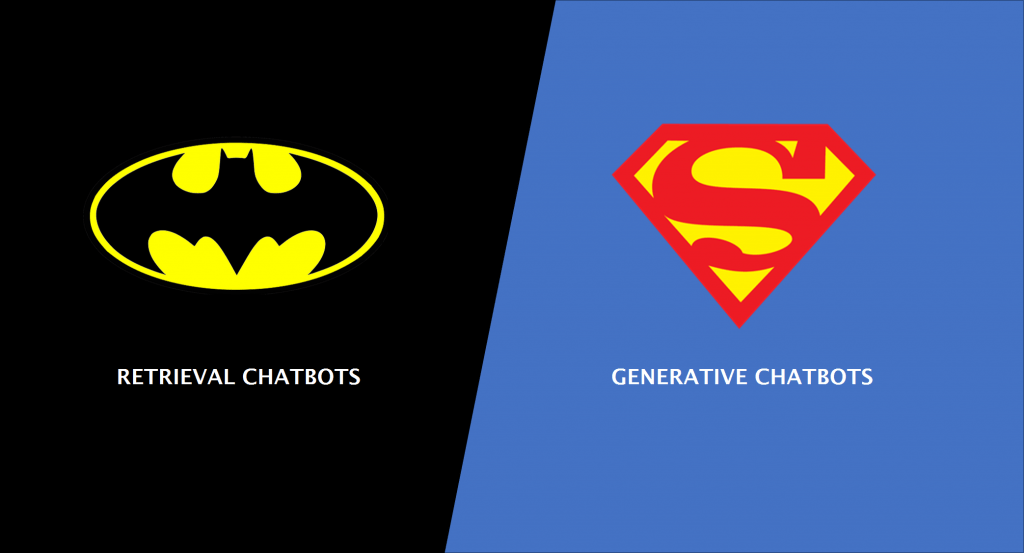
And when we take this analogy to chatbots, Batman is our trusted Retrieval model chatbot, while Superman is the Generative model.

We spoke about chatbots in our previous post, Chatbots – a botched play or a game changer?, and in this post, we dive a bit deeper.

Now what are retrieval and generative models?

Retrieval Chatbots

Retrieval chatbots can be understood in the form of a database and queries. There are scripted answers to scripted or near scripted questions. Let’s take an example.

Josh – the book recommending bot

Josh is a virtual assistant bot that suggests books depending on the genre entered by the user. Ben wants to gift his 9-year old niece a book. Watch how Ben (the user) interacts with Josh.

Retrieval Chatbot example - Josh

Here, the chatbot is retrieving titles as per the genres listed in its database and suggesting books to the user. This is a matching mechanism at work. A query is fired and that fetches a response from the database. Easy, peasy.

But many bots are failing this spectacularly, by not being able to tackle out of syllabus questions. Or not being able to empathize, to understand sarcasm or the worst of all, irony.

Retrieval bots are slowly improving and with breakthroughs in NLP, we might just be able to make them work better.

Generative Chatbots are different in the sense that they don’t follow the script.  They communicate with human users and learn to think on their feet and offer new lines.

Alice is an excellent example of an artificial intelligence bot that can have a fairly reasonable conversation with humans. No wonder, Alice won the Loebner prize thrice! Apple’s Siri is another amazing goal-based dialog agent. But these agents follow given heuristic patterns. Generative chatbots are those that use probabilistic techniques on existing data and create new lines. Deep Neural Network is the breakthrough technology that is helping shape generative chatbots, such as the LnH.

A Twitterbot , the LnH: The Band can compose on-demand new music based on the genre entered by the user. It has created 700 such new songs!


Let’s now look at another example of generative chatbots – Microsoft Tay. Tay, for those who aren’t aware, was the conversational AI chatbot that interacted with Twitter users and learnt with each tweet. It generated new content on its own, depending on what was tweeted to it. It was going pretty well, until people started training it to post racist comments.

A timeline view of Tay going from angelic to NSFW:

It becomes especially difficult when the chatbot has an open domain setting, that is, in the absence of a very specific goal. The chatbot cannot be programmed for just a few keywords and must communicate intelligently with the human on a larger set of topics. It sounds impossible, but research on deep learning is still on to make generative models work. The who’s who of the tech world – Google, Facebook, IBM and Microsoft – is piling up billions of dollars to solve the question mystifying us all – intelligence.

What chatbot should my business adopt?

It may seem like a fire or frying pan situation as Generative Chatbots are unpredictable and Retrieval Chatbots don’t know to handle irregular situations. So, the best solution, that businesses ideally ought to follow are a combination of Retrieval and Generative chatbots. Superman and Batman combined?

Excellent deduction plus massive strength?

Since that may be awhile in the oven, businesses are now going the retrieval mode. We looked at some of the top businesses out there using retrieval chatbots:

  1. Burberry

A renowned name in luxury fashion, they spare no expense for their bot, the Burberry Messenger Bot, either. Users can enter product keywords and browse through new products.

The chatbot displays a teaser video and provides a key button to touch. This speaks volumes of how the brand is trying to increase the bot’s appeal and thereby enhance customer engagement.

2. Dominos

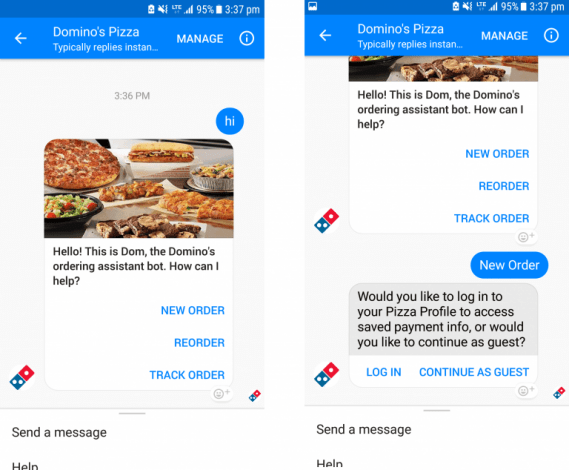
A bigshot in the fast-food industry, Dominos helps its customers order pizzas using its chatbot for door delivery and carryout. The customer can now order via the Messenger chatbot and just pick up the order from the outlet when it is ready. The bot also offers order tracking facilities so that you don’t need to keep calling the delivery guy a hundred times.


3. Ebay

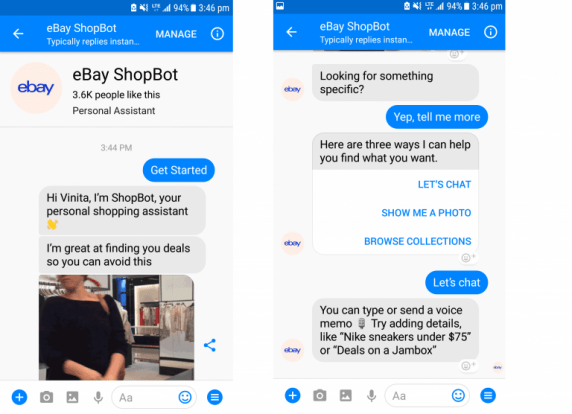
Conversational Commerce anyone? Ebay is on Messenger now, and it offers personal shopping assistance in the form of ShopBot.

Batman, that is, retrieval chatbot seems to be a safe bet – it is trained to answer specific questions and achieve a specific goal. You can be assured of not finding any grammatical errors, but be ready to face some annoyed customers when they at times it prompts “I am unable to understand that.”, or something of that sort. Retrieval chatbots do not yet possess artificial intelligence and it may seem like ‘the person is there but the lights are dim’. But the most important point is that they can be trained better using NLP and Machine Learning. Generative Chatbots are still not there yet. The work is on, and we are on the brink of technological advancements that can make these chatbots come alive with intelligence of their own.

At AgilizTech, we believe that chatbots are going to be the medium of B2C and B2B conversation in the near future. We’re exploring this exciting new realm of possibilities and are gearing up to leverage AI and Machine Learning to build revolutionary chatbots.

AgilizTech
Privacy Overview

This website uses cookies so that we can provide you with the best user experience possible. Cookie information is stored in your browser and performs functions such as recognising you when you return to our website and helping our team to understand which sections of the website you find most interesting and useful.