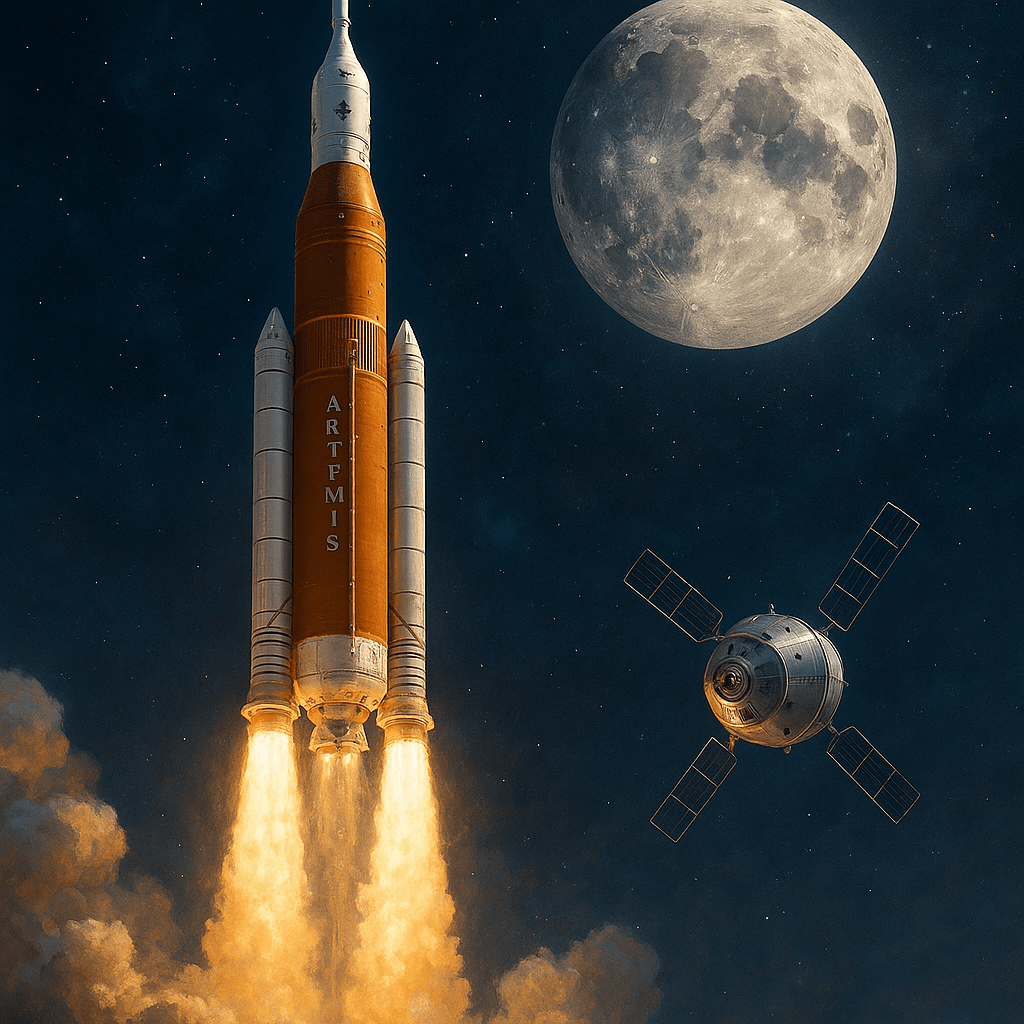
Artemis II: Launch Day Sparks a New Era of Space Exploration
On the cusp of making history, NASA’s Artemis II mission launched from Kennedy Space Center’s Launch Complex 39B, carrying a crew destined for a groundbreaking journey around the Moon. This mission not only marks the first crewed flight under NASA’s Artemis program but also sets the stage for humanity’s next steps toward deeper space exploration.
As the clock ticked toward zero, Artemis II was poised with the Space Launch System (SLS) rocket and the Orion spacecraft, aptly named Integrity. The rocket’s massive twin solid rocket boosters, each towering 177 feet tall, and four RS-25 engines provided a combined thrust of 8.8 million pounds at liftoff, propelling the 5.75-million-pound behemoth skyward.
In a meticulous orchestration of technology and human endeavor, the countdown sequence became a symphony of precision. From the initiation of the ground launch sequencer to the retraction of the crew access arm, every step was a testament to the years of planning and innovation that brought Artemis II to this pivotal moment.
The successful deployment of Orion’s solar array wings shortly after launch was a crucial milestone. Extending to a wingspan of approximately 63 feet, these arrays play a vital role, harnessing solar energy through 15,000 solar cells to power the spacecraft throughout its journey.
However, the path to the Moon involves more than mere technological prowess. The Artemis II mission pioneers cutting-edge procedures as part of its itinerary, including the proximity operations demonstration. This exercise will test Orion’s capability to manually maneuver relative to another spacecraft post-separation, using onboard navigation sensors and reaction control thrusters. The ICPS, detached as Orion’s stage target, becomes the focus of maneuvers that hone the spacecraft’s precision handling in space—a prelude to future lunar missions.
On the ground, mission control remains vigilant, addressing any anomaly. Even a quirky hiccup, such as a blinking fault light on Orion’s toilet system, is met with coordinated problem-solving. This diligence underscores the layered complexity of long-duration missions, where even the smallest systems play significant roles in crew comfort and mission success.
Artemis II isn’t just about gearing up machinery; it’s about human resilience and exploration spirit. Astronauts Reid Wiseman, Victor Glover, Christina Koch from NASA, and Jeremy Hansen from the Canadian Space Agency are not only the crew; they are pioneers pushing the frontier of human presence in space. As they engage in their tasks and face unknown variables, they embody humanity’s collective ambition to reach beyond our terrestrial confines.
The mission’s comprehensive goals extend beyond mere lunar flybys. They include critical testing of life-support systems and other spacecraft operations, all vital for future landings on the lunar surface and the long trek towards Mars. The Artemis initiative symbolizes more than exploration; it signifies the possibility of scientific advances and economic opportunities on the Moon and beyond.
As Artemis II continues its trajectory, it holds the world’s gaze, a beacon of technological progress and human courage. This mission is a leap forward, not just a circuit around the Moon but a trajectory into a future where space becomes a canvas for human aspiration and innovation. With each milestone, from the apogee raise burn to the proximity operations, NASA writes a new chapter in space exploration, stepping stones to Mars and beyond, heralding a future where limitless horizons beckon.